AI/ML Engineer

Hello, I am Deepak Singh

B.Tech CSE (2026) Graduate & AI Engineer specializing in LLM-powered applications, Retrieval-Augmented Generation (RAG) pipelines, and production machine learning systems.

Initializing...
Drag to rotate • buttons to scramble/solve

01 — About

Deepak Singh
0
Tech Stack
0
Key Projects
Degrees
0
Best Time

I'm a B.Tech CSE (2026) graduate and AI Engineer who builds LLM-powered applications, Retrieval-Augmented Generation (RAG) pipelines, and production-grade machine learning systems.

I design end-to-end AI solutions: scalable backend APIs, MLOps workflows with Docker, MLflow and CI/CD, and cloud deployments, using Python, FastAPI and Flask. My foundation spans machine learning, deep learning and software engineering, and I have a track record of shipping deployable AI products, including Kaggle competition work.

Deepak Singh
0
Tech Stack
0
Key Projects
2
Degrees
0
Best Time

Tap to flip ↻
🛡️
AI Engineer Intern
CyCrew · AI-assisted SIEM incident response
Oct 2025 – Jan 2026
  • Problem: SOC analysts triage SIEM alerts by hand, and an LLM on its own can invent remediation steps. I built a prototype that turns a raw alert or log dump into a structured incident report with response steps.
  • My work: the RAG service (FAISS + BGE-small-en over 11 attack playbooks), two n8n workflows using Gemini 2.5 Flash-Lite with structured JSON output, a FastAPI result store, and the Vue.js dashboard.
  • Key decision: two input paths. Classified alerts are grounded in a retrieved playbook and the prompt forbids invented steps; unclassified logs go to the model with a prompt that must cite evidence and not assume an attack.
  • Status: working prototype exercised on sample alerts and logs; not yet benchmarked. Known gap: retrieval has no similarity threshold, so an unknown alert type can still receive the nearest playbook.
RAG / LLMs FAISS FastAPI n8n Vue.js
⚡ Quick Summary
AI Engineer Intern · CyCrew
  • What: SOC assistant prototype. A SIEM alert or raw logs go in, a structured incident report comes out
  • Users: SOC analysts doing first-pass triage; it supports their review and never acts on systems itself
  • Known alerts: matched to one of 11 attack playbooks (phishing to data exfiltration) and grounded in its mitigation and recovery steps
  • Unknown logs: analysed by the LLM from evidence only, citing IPs, users and timestamps, with "no attack" allowed
  • Output: attack detected, type, confidence and mitigation steps, shown as cards in a live incident feed
  • Stack: Vue · n8n · FastAPI · FAISS · Gemini 2.5 Flash-Lite
  • Status: prototype, not yet benchmarked. Next: similarity threshold, labelled test set, persistent storage
Read case study →
Tap to flip ↻
🤖

LLMs & Generative AI

Building grounded, retrieval-powered AI products.

LLM AppsRAGFAISSEmbedding ModelsPrompt EngineeringAgentic Workflows
📊

Machine Learning & Data Science

From messy data to evaluated, tuned models.

Scikit-learnTensorFlowXGBoostPandasNumPyFeature EngineeringModel Evaluation
⚙️

Backend & APIs

Fast, clean services that ship models to users.

PythonJavaSQLFastAPIFlaskREST APIsn8n
🚀

MLOps & DevOps

Reproducible pipelines, CI/CD and cloud deploys.

GitDockerJenkins CI/CDMLflowGoogle Cloud (GCP)
04 — Projects

Featured Projects

Click “Read details” on any project to see the full description

PROJECT / 01
📅 Jun 2025 – Aug 2025
Hotel Reservation Prediction
End-to-end ML + MLOps pipeline predicting hotel booking cancellations, from GCS ingestion to Jenkins CI/CD deployment on GCP.
MLflowDocker / GCPJenkins
GitHub →
PROJECT / 02
📅 May 2025 – Jun 2025
Virtual Data Analyst Agent
AI-powered API that uses LLMs to automatically source, prepare, analyze and visualize data, with a self-correcting code loop.
LLM AgentAPI
GitHub →
PROJECT / 03
📅 Jan 2026 – Feb 2026
Legal Document Classification — Kaggle
Classified legal documents into 30 classes by fine-tuning a transformer with LoRA, training only ~0.8% of the parameters.
LoRA / PEFTTransformers
GitHub →
PROJECT / 04
📅 Mar 2025 – Apr 2025
Virtual Teaching Assistant
RAG-powered API that answers student queries from course and forum content, with reference links, in under 30 seconds.
RAGEmbeddings
GitHub →
PROJECT / 05
📅 Feb 2026 – Mar 2026
Engage2Value — Kaggle Competition
Predicted customer purchase value from multi-session behavior. R² 0.6813, rank 152 of 1500 teams (top 10%).
XGBoostFeature Engineering
GitHub →
PROJECT / 06
📅 Sep 2025 – Nov 2025
Household Services Management
Full-stack platform connecting households with service providers for booking, scheduling and management.
Flask + VueRedis / Celery
GitHub →
Tap to flip ↻
🎓
B.Tech, Computer Science and Engineering
Dronacharya College of Engineering, Gurgaon
Jun 2022 – Jul 2026
📘 Summary
Dronacharya College of Engineering, Gurgaon
  • Core CS: data structures, algorithms, DBMS, operating systems, networks
  • Specialised on my own in AI/ML, LLMs and RAG systems
  • Shipped real projects, an industry internship and Kaggle results alongside coursework
Tap to flip ↻
🎓
BS in Data Science and Applications
Indian Institute of Technology (IIT), Madras
Sep 2022 – Sep 2026
📘 Summary
Indian Institute of Technology (IIT), Madras
  • Online degree focused on statistics, programming and machine learning
  • Hands-on with data analysis, modelling and application development
  • Studied in parallel with my B.Tech
Tap to flip ↻
AWS Certified Cloud Practitioner
Amazon Web Services
🧠 Skills I Gained
  • AWS cloud concepts & global infrastructure
  • Core services (EC2, S3, IAM, VPC)
  • Security & shared responsibility
  • Pricing, billing & support
View Certificate
Tap to flip ↻
Amazon ML Summer School
Amazon
🧠 Skills I Gained
  • Supervised & unsupervised learning
  • Deep learning & neural networks
  • Generative AI & LLM fundamentals
  • Reinforcement learning basics
View Certificate
Tap to flip ↻
Advanced Learning Algorithms
DeepLearning.AI / Stanford University
🧠 Skills I Gained
  • Neural networks (TensorFlow)
  • Decision trees & ensembles
  • XGBoost
  • Bias / variance tuning
View Certificate
Tap to flip ↻
SQL
Udemy
🧠 Skills I Gained
  • Querying & filtering with SELECT
  • Joins & subqueries
  • Aggregations & GROUP BY
  • Database design basics
View Certificate
Tap to flip ↻
FastAPI
Udemy
🧠 Skills I Gained
  • REST API design
  • Pydantic validation
  • Async endpoints
  • Dependency injection
View Certificate
Tap to flip ↻
Applied Skills: NLP Solution with Azure AI Language
Microsoft
🧠 Skills I Gained
  • Text classification
  • Entity recognition
  • Summarization
  • Question answering
View Certificate

Detailed deep-dives into ML and AI systems.

Tap to flip ↻
Why RAG Systems Fail Even When Retrieval Works cover
RAG & LLM Systems
Why RAG Systems Fail Even When Retrieval Works
A look at what goes wrong after retrieval
Retrieving the right documents is only half the job. This article looks at why RAG pipelines still produce wrong or ungrounded answers even when retrieval looks healthy.
Author: Deepak Singh
Why RAG Systems Fail Even When Retrieval Works
Executive summary

The problem

RAG systems are usually debugged at the retrieval layer: better embeddings, better chunking, higher recall. But a correct set of retrieved chunks does not guarantee a correct answer.

Where it breaks

  • Relevant context is retrieved but buried, truncated or diluted by noisy chunks.
  • The model ignores the context and answers from its own prior knowledge.
  • Conflicting or outdated chunks confuse the generation step.
  • Evaluation only measures retrieval, so generation failures go unnoticed.

Takeaway

Retrieval quality and answer quality are different problems. Evaluate them separately, and measure whether the final answer is actually grounded in the retrieved context.

The full article covers the failure modes in detail.

Scroll to read summaryView PDF
Tap to flip ↻
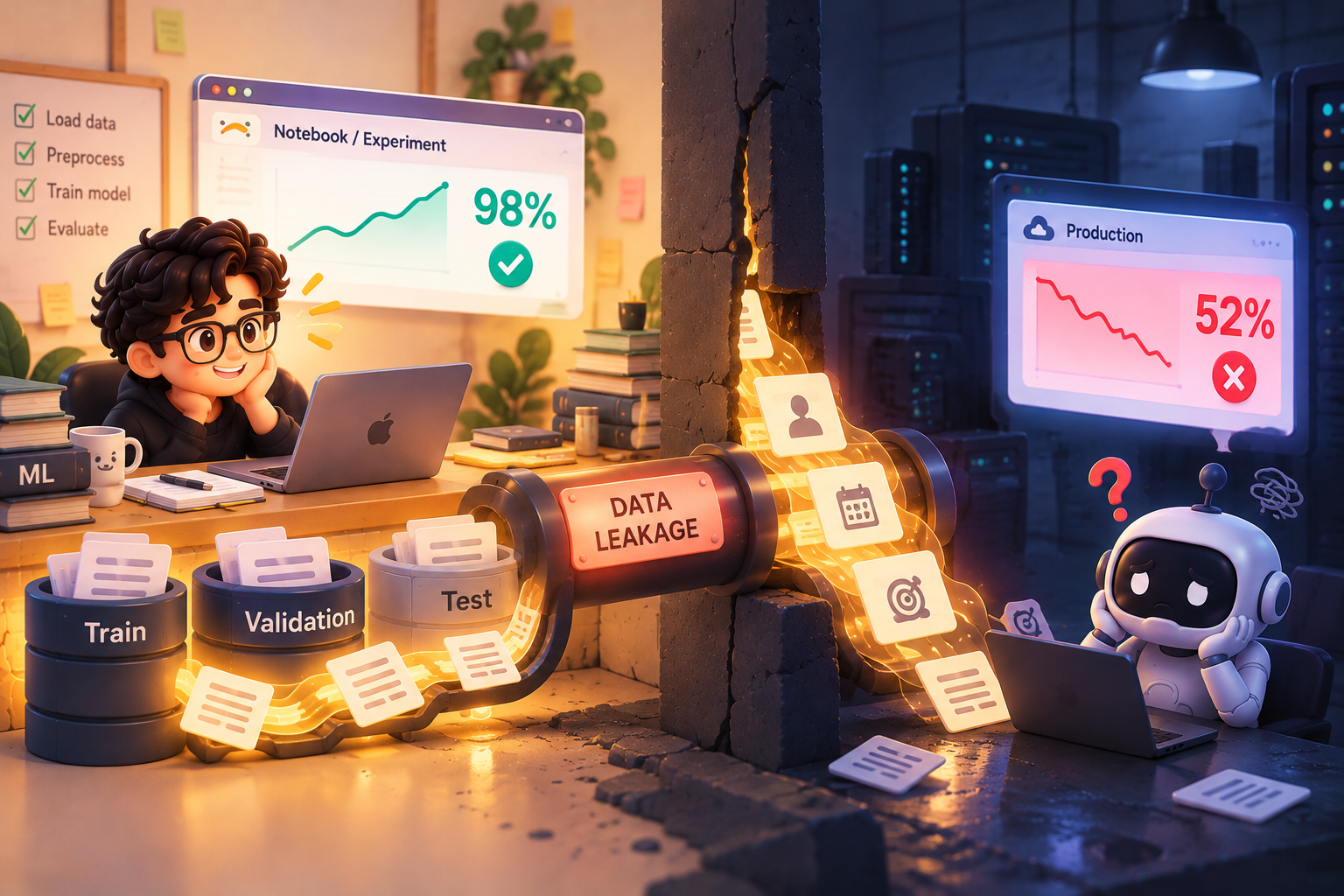
Detecting Data Leakage in ML cover
ML Evaluation
Detecting Data Leakage in ML
Why great validation scores can lie
Data leakage silently inflates model performance and then collapses in production. This article covers how leakage happens and practical ways to detect it.
Author: Deepak Singh
Detecting Data Leakage in ML
Executive summary

The problem

A model that scores suspiciously well often has access to information it would never have at prediction time. The metrics look great, and the deployment fails.

Common sources

  • Preprocessing (scaling, encoding, imputing) fitted before the train/test split.
  • Target leakage through features that encode the label.
  • Duplicate or near-duplicate rows across train and test.
  • Temporal leakage from random splits on time-dependent data.

Takeaway

Treat unusually high scores as a warning sign. Split first, fit transformations on training data only, and audit feature importance for features that look too good to be true.

The full article walks through detection techniques.

Scroll to read summaryView PDF

Interested in my work? Let’s connect.